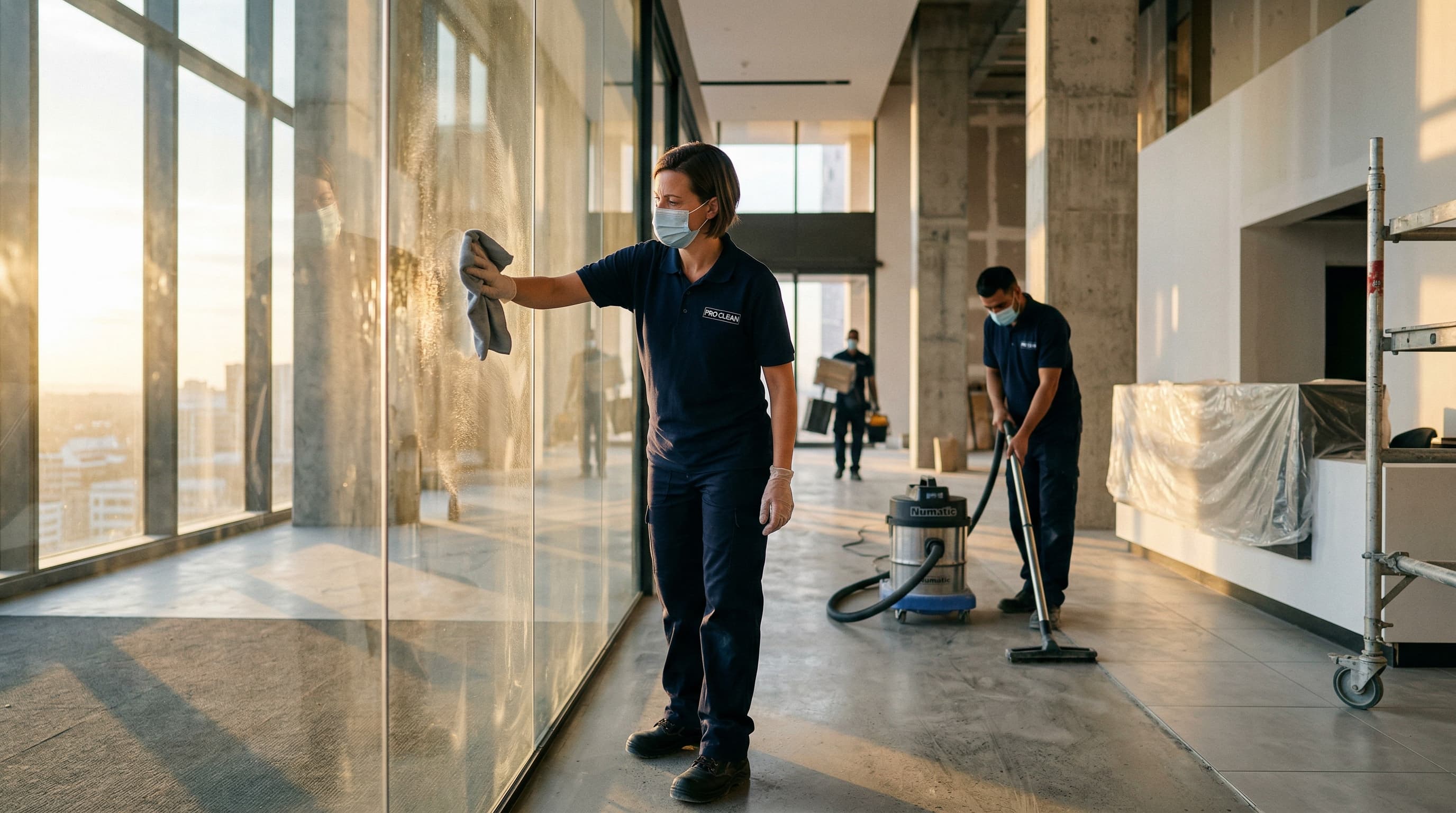
What's Included in a Post-Construction Cleanup? A Complete NJ Guide
Everything facility managers and property developers need to know about post-construction cleanup in New Jersey — phases, scope, timeline, and what to expect before move-in.
Your renovation just wrapped. The contractors packed up, the drywall dust settled, and the space looks... almost ready. Almost. Because between "construction complete" and "ready for occupancy," there's a critical step that determines whether your building feels finished or feels like a job site someone swept once.
Post-construction cleanup isn't optional. It's the difference between a space that's safe to occupy and one that's hiding drywall dust in every vent, adhesive residue on every window, and fine particulate in the air your tenants are about to breathe.
Why Post-Construction Cleanup Requires Specialists
General janitorial crews aren't equipped for this work. Post-construction cleanup involves hazards and debris types that standard cleaning doesn't address — concrete splatter, paint overspray, grout haze, metal shavings, silica dust, adhesive film, and construction-grade sealants.
It also requires a specific sequence. Cleaning windows before clearing duct debris means you'll be cleaning the windows again. Mopping floors before removing overhead dust means you'll be mopping again. A professional post-construction cleanup follows a top-down, phased approach that prevents rework and gets the space move-in ready efficiently.
For facility managers and developers in New Jersey, understanding what's actually included in this process helps you budget accurately, set realistic timelines, and avoid getting burned by crews that skip steps.
The Three Phases of Post-Construction Cleanup
Professional post-construction cleanup happens in three distinct phases. Each one builds on the last, and skipping phases leads to problems down the road.
Phase 1: Rough Clean
The rough clean happens while construction is still wrapping up — typically once framing, mechanical, and drywall are complete but before final finishes go in.
- Remove all large debris — scrap lumber, drywall pieces, packaging, wire scraps, broken materials
- Sweep and shovel all floors — clear loose dirt, concrete chunks, and sawdust
- Vacuum all surfaces with HEPA-filtered equipment to capture fine particulate
- Wipe down exposed ductwork and HVAC components before ceiling tiles or covers go in
- Clean windows of stickers, tape, and protective film
- Remove any standing water and address moisture issues before finish work begins
This phase is primarily about getting the space safe and functional enough for finish crews to do their work without tracking debris through completed areas.
Phase 2: Light Clean
The light clean happens after most finish work is complete — paint, flooring, fixtures, and cabinetry are installed.
- Detail clean all installed fixtures — light fixtures, outlet covers, switch plates, hardware
- Remove paint splatter and overspray from windows, trim, and hardware
- Clean all glass and mirrors — remove labels, film residue, and smudges
- Wipe down all cabinetry and countertops inside and out
- Vacuum all carpeted areas and damp mop all hard floors
- Clean restrooms — toilets, sinks, mirrors, partitions, tile
- Dust all horizontal surfaces — shelves, ledges, windowsills, door frames
At this point, the space is starting to look like a finished building rather than a construction zone.
Phase 3: Final Clean (Touch-Up)
The final clean is the last pass before occupancy. It's the detail work that separates a "cleaned" building from one that's genuinely ready for people.
- Spot-check every surface for remaining dust, smudges, and debris
- Polish all fixtures and hardware — faucets, handles, hinges, locks
- Clean and buff all flooring — VCT gets a fresh strip and wax, hard surfaces get sealed
- Address grout haze on tile — this requires specific chemicals and technique
- Detail clean all window tracks and frames — not just the glass
- Vacuum HVAC vents and registers one final time
- Touch up any areas impacted by final punch list work
- Remove all cleaning equipment and supplies from the site
After this phase, the space should be ready for furniture installation and move-in.
What Gets Missed When Corners Are Cut
The most common complaints from property managers after a post-construction cleanup usually come down to the same handful of shortcuts:
Ductwork and vents. Construction generates enormous amounts of fine dust. If the HVAC system wasn't properly cleaned and sealed during construction, that dust gets circulated through the entire building the moment the system kicks on. Proper sanitization and disinfection of air handling components isn't optional — it's a health issue.
Window tracks and frames. Crews clean the glass but skip the tracks. Dust, caulk residue, and debris sit in the channels, and the first time someone opens a window, it all comes loose.
Inside cabinets and closets. Drywall dust settles everywhere during construction — including inside every cabinet, drawer, and closet. If these aren't individually wiped down, the first person to open them gets a face full of dust.
Light fixtures and ceiling areas. Dust on top of light fixtures eventually heats up and creates that burnt-dust smell. Ceiling tiles and grid systems trap fine particles that slowly release into the occupied space.
Floor edges and corners. A quick mop pass across the center of the floor looks clean until you look at the baseboards. Construction debris collects along edges and in corners where standard mopping doesn't reach.
Timeline: How Long Does Post-Construction Cleanup Take?
This depends on the size of the project, the type of construction, and how clean the contractors left the site.
- Small commercial spaces (under 5,000 sq ft): 1–3 days for all three phases
- Mid-size offices and retail (5,000–20,000 sq ft): 3–7 days
- Large facilities (20,000+ sq ft): 1–3 weeks, often phased to align with construction completion by floor or section
For renovation projects in occupied buildings, the timeline also needs to account for working around active tenants and coordinating with ongoing building maintenance.
One factor that significantly impacts timeline: whether the general contractor maintained reasonable cleanliness during construction. A GC that required daily cleanup from their subs leaves a much more manageable job than one that let debris accumulate for months.
What to Look for When Hiring a Post-Construction Cleaning Crew
Not every commercial cleaning company handles post-construction work. Here's what to verify before signing a contract:
-
Experience with your building type. Cleaning a newly built medical office is very different from cleaning a renovated warehouse. Ask for references from similar projects.
-
HEPA filtration equipment. Standard vacuums recirculate fine construction dust. HEPA filtration captures particles down to 0.3 microns — essential for drywall and concrete dust.
-
Insurance and bonding. Post-construction cleanup carries more risk than standard janitorial work. Verify general liability, workers' compensation, and bonding coverage before any crew enters your building.
-
Clear scope of work. Get the specifics in writing — which phases are included, what surfaces are covered, how many passes are guaranteed. A vague proposal leads to vague results.
-
Punch list coordination. The best cleanup crews work in coordination with the GC's punch list process. As punch list items get completed, touch-up cleaning follows. This avoids the "we cleaned it but then someone came back to fix a door" problem.
If you're evaluating how to choose the right cleaning company for this kind of work, the stakes are higher than routine janitorial — your certificate of occupancy timeline may depend on it.
Cost Factors for Post-Construction Cleanup in NJ
Post-construction cleanup is priced differently from recurring cleaning services. Most NJ companies price it per square foot, with rates typically ranging from $0.15–$0.75 per square foot depending on:
- Type of construction — new build vs. renovation, interior vs. full gut
- Condition of the site — how much debris the GC left behind
- Number of phases included — rough + light + final vs. final only
- Special requirements — window cleaning for multi-story buildings, pressure washing exterior concrete, floor finishing
For a deeper dive on how commercial cleaning pricing works across different service types, see our NJ pricing guide.
Get Your New Space Move-In Ready
Whether you're wrapping up a ground-up build, a tenant improvement, or a full-building renovation, C&S Commercial Cleaning handles all three phases of post-construction cleanup for commercial properties across New Jersey.
We coordinate directly with your GC, work around your construction schedule, and don't consider the job done until the space passes a final walkthrough with your team.
Request a free post-construction cleanup estimate — we'll visit the site, assess the scope, and have a proposal to you within 48 hours.
Need a Professional Opinion?
Get a complimentary onsite assessment of your commercial space in New Jersey.
Request Consultation