Office HVAC and Air Quality: What NJ Facility Managers Should Schedule Before Summer
Pollen, humidity, and overdue duct work hit NJ commercial buildings hard in May. Here is the air quality maintenance checklist to handle before the AC runs full time.
Walk into most NJ office buildings the first week of May and you can smell what is coming. The HVAC ran in heat mode through April, the windows have been closed for six months, and the pollen count on the Jersey coast just hit 9.5 on the Ocean County allergy index. The AC is about to start running ten hours a day, every day, and whatever is sitting in the ductwork, on the coils, and in the filter housings is about to circulate through every desk in the building.
This is the maintenance window. Late April through mid-May is the only time of year when commercial HVAC sits roughly idle in New Jersey. Once the temperature stays above 75 degrees, the system runs constantly and any service call means downtime, complaints, and overtime rates. Schedule the work now.
We service commercial buildings across Monmouth and Ocean County, and the buildings that get this checklist done in early May spend the rest of the summer with cleaner air, lower utility bills, and zero "the office smells weird" complaints. Here is what should be on the list.
Why Does Indoor Air Quality Get Worse in May for NJ Offices?
Three things stack up at once. None of them are obvious until people start coughing.
First, pollen. The NJ shore plus inland Monmouth and Ocean County run heavy on oak, birch, and grass pollen from late April through June. Pollen pulls in through every fresh-air intake on the building. Without a filter swap, that pollen recirculates inside the building for weeks.
Second, humidity. Coastal NJ humidity climbs from 55% in March to 75%+ by late May. Cooling coils that have been dormant since October are now condensing moisture continuously. Anything biological sitting in the drain pan, on the coil fins, or in the ductwork has ideal conditions to grow.
Third, mode switch. Heat-mode runtime in spring is short bursts. AC runtime is sustained. The first sustained AC cycle of the season pushes any accumulated dust, dander, and debris through the duct system at full velocity for the first time in seven months.
If nothing was done over the winter, that first hot week of May is when occupants start complaining. Headaches. Allergy symptoms that do not match what is happening outside. Stuffiness in conference rooms. The smell people describe as "old."
What HVAC Maintenance Should Be Done Before Summer Hits?
The list below is what we coordinate with HVAC contractors on the buildings we clean. The cleaning side of this is what our crews handle directly. The mechanical side requires an HVAC tech, and you should have one on a service contract for any building over 5,000 square feet.
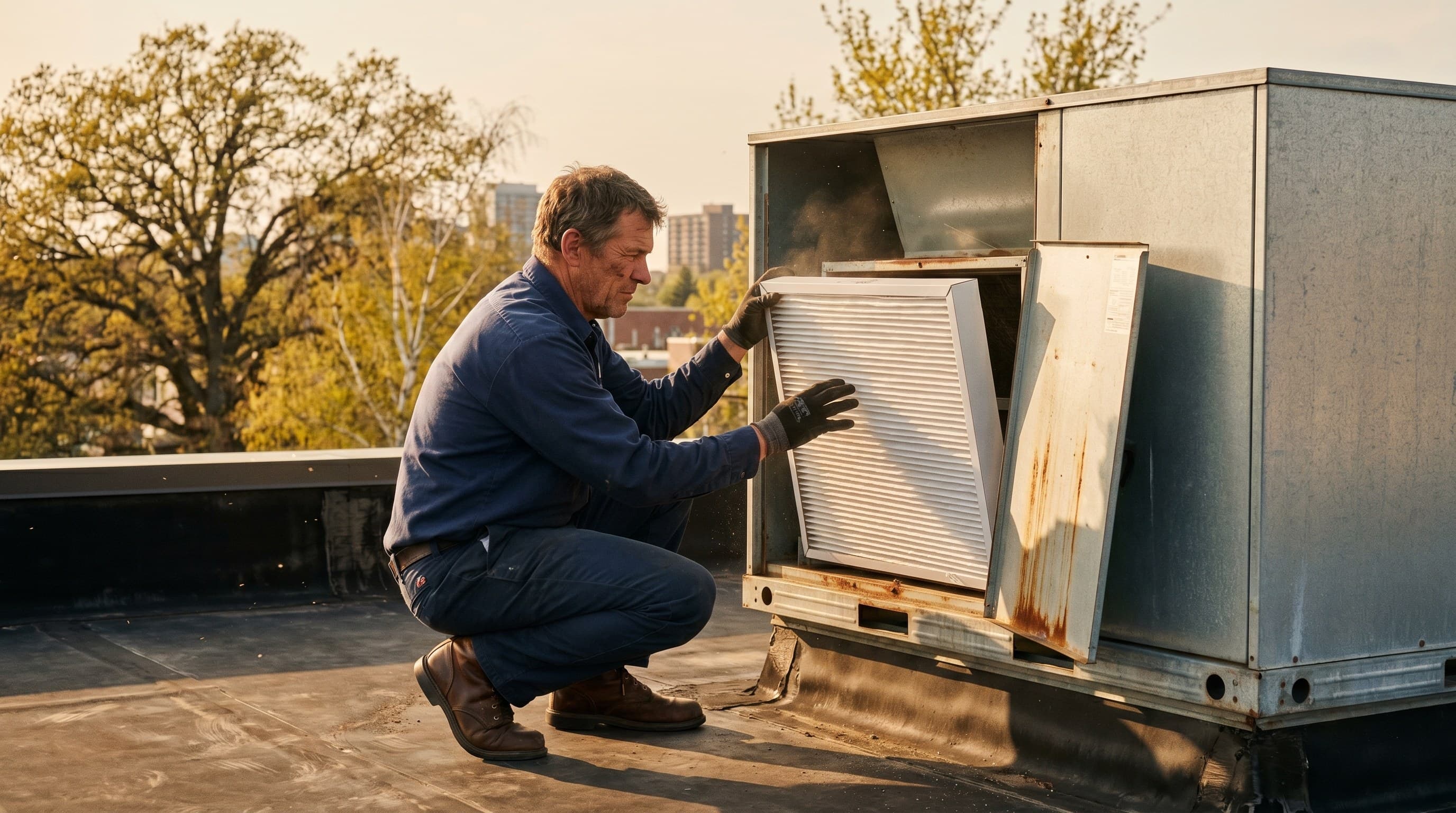
- Replace every filter in the building. Not "check." Replace. Even if the filter looks fine. Filters that sat through six months of low-flow operation are loaded with fine particulate that releases when AC airflow ramps up. Move from MERV 8 to MERV 11 or MERV 13 if your system handles the static pressure. Most modern commercial units can.
- Clean cooling coils and drain pans. Biofilm builds up in drain pans every year. A dirty drain pan is a humidifier full of bacteria. The coil itself loses 15 to 20% of its cooling efficiency for every layer of dust. Coil cleaning pays for itself in lower utility bills before July.
- Inspect and clean fresh-air dampers and intakes. Birds, leaves, and pollen pile up in louvered intakes through spring. Clogged intakes force the system to recirculate stale air.
- Service rooftop units (RTUs). Every RTU on a flat-roof commercial building needs annual service: belts, bearings, refrigerant charge, electrical contactors, and condenser coil cleaning. The condenser coil on a rooftop unit takes the worst of NJ's winter and salt-air corrosion. A clogged condenser coil in July is the most common cause of mid-summer system failure.
- Bleach and clean condensate drain lines. Algae growth in drain lines is the number one cause of summer water damage in commercial buildings. The drain backs up, the secondary pan fills, and water either drips through ceiling tiles or trips a float switch that shuts down the AC entirely.
- Test economizers and outside-air controls. A stuck-open economizer in July pulls in 90-degree humid outside air and tries to cool it. That is one of the easiest fixes that gets missed every spring.
What Does Duct Cleaning Actually Do for an Office?
Duct cleaning is one of the most over-sold and under-explained services in the commercial cleaning industry. Here is the honest version.
If your building is older than ten years, has carpet, has had any renovation work in the last three years, or has had any water damage that was caught quickly but not fully remediated, you have material in your ducts that does not belong there. Drywall dust from renovations. Settled pollen and dander from years of HVAC cycles. Carpet fibers. Construction debris.
Duct cleaning removes it. A proper commercial duct cleaning uses negative-pressure equipment that pulls debris out through a single collection point while compressed air agitates the inside of the duct. Done correctly, it is a one-day job for a typical 10,000 square foot office and does not generate any mess inside the occupied space.
What duct cleaning does not do: solve a mold problem, replace HVAC service, or fix an air quality complaint that is actually caused by a water leak, off-gassing carpet, or a clogged filter. We sometimes get called in to quote duct cleaning when the actual problem is a filter that has not been changed in eighteen months. Always check the obvious things first.
The honest signal that you need duct cleaning: pull a register cover off and look inside with a flashlight. If you see visible buildup on the duct walls or fiberglass insulation has degraded into the airstream, schedule the work. If the duct is clean and the filter is loaded, change the filter and reassess.
For most NJ commercial buildings, duct cleaning is a 3 to 5 year service interval, not annual. Filter changes and coil cleaning are annual. We covered the difference between routine janitorial work and these deeper interventions in our janitorial vs deep cleaning guide.
What Should Cleaning Crews Handle Versus HVAC Techs?
There is a hard line between mechanical service and cleaning service, and getting it wrong wastes money on both sides.
| Task | Who Does It | Frequency | |------|-------------|-----------| | Filter replacement | HVAC tech or trained facility staff | Every 1 to 3 months | | Coil cleaning, drain pan service | Licensed HVAC tech | Annual, before summer | | Refrigerant, belts, electrical | Licensed HVAC tech | Annual | | Vent and register face cleaning | Commercial cleaning crew | Quarterly | | Diffuser and grille wipe-down | Commercial cleaning crew | Monthly with deep cleans | | Floor and base trim where supply diffusers blow down | Commercial cleaning crew | Weekly | | Duct interior cleaning | Specialized duct cleaning vendor | 3 to 5 years | | Carpet extraction near supply registers | Commercial cleaning crew | Twice yearly |
The cleaning side matters more than people realize. Vent grilles trap pollen and dust on their fins and blow it back into the room every cycle. A monthly wipe-down keeps the visible part of the airstream clean and stops the "why is there always dust on my desk" complaint. Carpet extraction within three feet of every supply register pulls out the load that gravity puts there from every cycle. We build both into our quarterly deep clean rotations for office and medical clients.
What Does This Cost a Typical NJ Office Building?
Real numbers from Monmouth and Ocean County buildings between 5,000 and 25,000 square feet.
- Annual HVAC PM (filters, coil clean, RTU service): $400 to $1,200 per RTU. Most small commercial buildings have 2 to 6 RTUs.
- One-time duct cleaning: $0.30 to $0.60 per square foot of building. A 10,000 sq ft office runs $3,000 to $6,000.
- Quarterly vent and grille cleaning as part of your existing janitorial contract: usually a small line-item add-on, $100 to $300 per service depending on count.
- Carpet extraction near supply registers: typically rolls into a standard deep carpet clean.
The PM and quarterly cleaning is non-negotiable. The duct cleaning is on a longer cycle and only worth it on the right schedule. The buildings we work with that handle all four together right before AC season starts almost never have summer air quality complaints.
What to Do This Week
Pick a Friday afternoon next week and walk the building with a clipboard. The list:
- Pull a register cover in three locations and look at the duct interior with a flashlight.
- Note the date on every filter access panel.
- Look at the rooftop or mechanical room. Note any visible drain pan staining or coil discoloration.
- Check that condensate drain lines are clear and have a working secondary pan or float switch.
- Walk the property perimeter for any blocked fresh-air intakes.
Take photos of what you find and send the list to your HVAC contractor with a request for service before May 20. Do the same to your cleaning company for the vent grilles and carpet work. Both should come back with line-item quotes within a week. Schedule the work for the same week if you can, so the building is reset for summer in one pass instead of three trips.
If your current cleaning contract does not include vent grille cleaning or supply-register carpet care, that is the conversation to have with us this month. We service offices, medical buildings, and retail spaces across Monmouth and Ocean County, and these are line items we can add into an existing schedule without changing your monthly rate. Send a photo of the worst-looking vent grille in your building to start. We will tell you what we would do, what it would cost, and whether it is something to handle now or roll into next quarter.
Need a Professional Opinion?
Get a complimentary onsite assessment of your commercial space in New Jersey.
Request Consultation